EFF Management & Distribution: Connecting Flight Planning to the EFB

Updated 7th April 2026
Ensuring the safety and efficiency of a flight, requires meticulous calculations and strict adherence to various aircraft parameters.
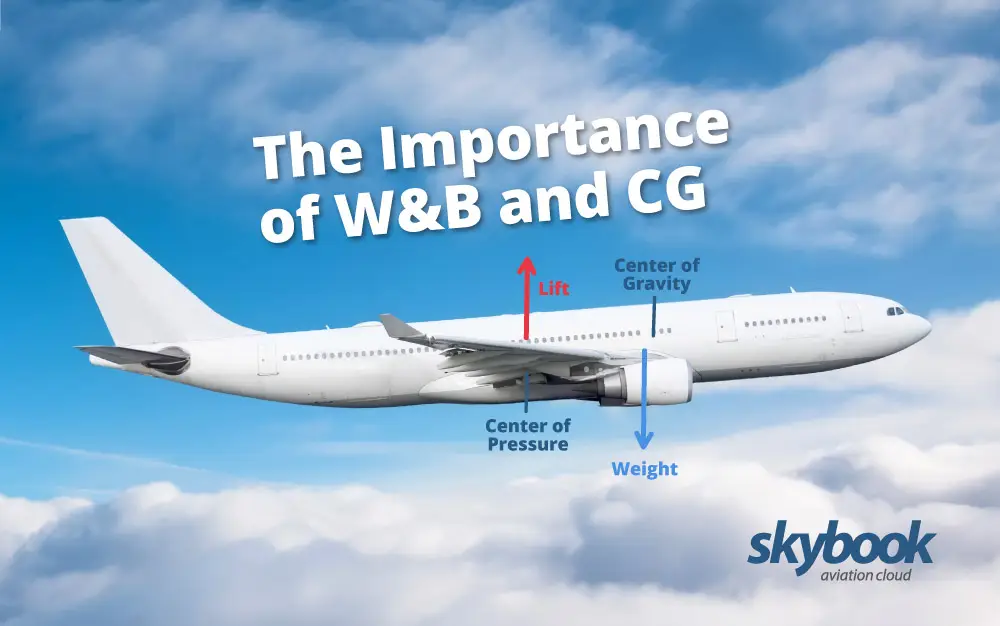
Two fundamental aspects are weight and balance (W&B), and Center of Gravity (CG).
These factors are integral to flight safety, performance and fuel efficiency.
In this article, I describe Weight and Balance and Center of Gravity, and how using weight & balance calculators within an EFB can streamline the process for pilots.
Weight in aviation refers to the mass of the aircraft and everything it carries, including fuel, passengers, cargo and crew. Managing this weight is essential, as exceeding the aircraft's maximum takeoff weight can lead to catastrophic failures.
Balance is the distribution of this weight.
Ensuring the aircraft is correctly balanced involves making sure that the weight is distributed in a way that the aircraft remains stable and controllable throughout the flight.
Incorrect weight and balance can impact an aircraft's performance, affect fuel efficiency, and reduce control capabilities, leading to critical safety issues.
Adhering to weight and balance limits is also a regulatory requirement in aviation.
The Center of Gravity is the point at which an aircraft's weight is considered to be concentrated and is the point around which the aircraft balances. This point is crucial because it affects the aircraft's stability and performance.
If the CG is too far forward or too far aft (back of an aircraft), the aircraft can become unstable or uncontrollable, leading to various potential incidents such as tail strikes, tail tipping, or even more fatal outcomes.
Traditionally, pilots would calculate W&B and CG manually, but digital tools such as the skybook Electronic Flight Bag (EFB) have improved this element of flight planning.
1. Empty weight
This is the weight of the aircraft without any payload (passengers, cargo, fuel).
2. Total aircraft weight
Add Payload and Takeoff Fuel. Include the weight of passengers, baggage, cargo, and fuel. Each item should be placed in its respective position in the aircraft.
3. Calculate the moment (weight x arm = moment)
Multiply the weight and arm (its distance from a reference point, usually the nose of the aircraft) to get the moment. This helps in determining how weight is distributed.
4. Center of gravity (moment ÷ weight = CG)
Add the total moment numbers and divide by the total weight gives the Center of Gravity position.
5. Ensure CG within Limits
Compare the calculated CG position with the aircraft's allowable CG envelope range, which is provided in the aircraft's flight manual.
Aviation software companies have created digital tools to simplify these calculations.
EFB Weight & Balance Tool:
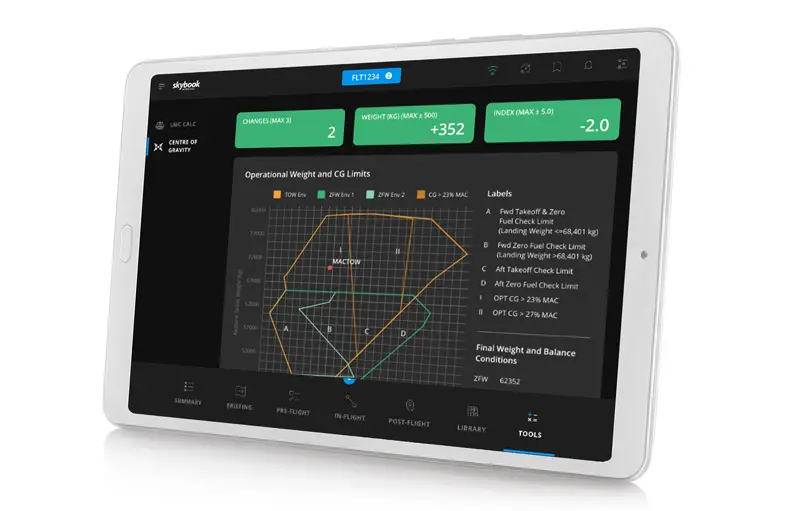
Digital tools on EFB’s can help pilots and dispatchers to quickly and accurately calculate weight and balance.
Center of Gravity Tool:
The C of G calculator ensures that the aircraft remains within the flight envelope. Allowing for efficient determination of calculations such as the aircraft's final zero fuel weight and final takeoff weight.
Last Minute Change Tool:
Last minute changes are made easy to calculate on EFB with changes also reflected in the C of G safe envelope. Read more on the LMC calculator.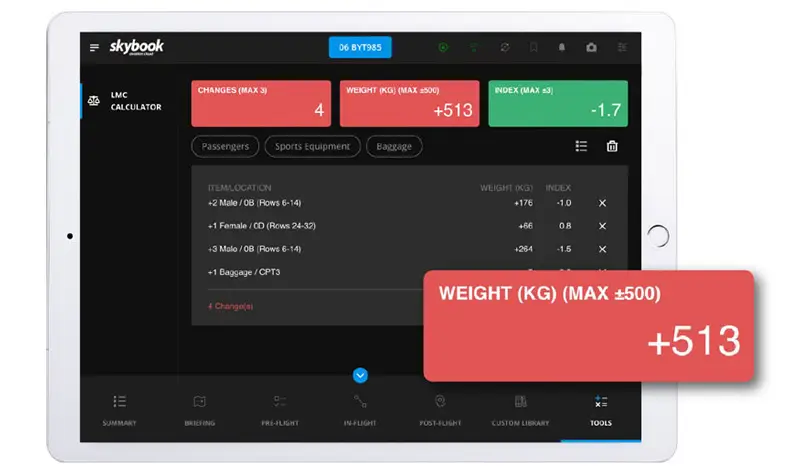
AID:
The use of Aircraft Interface Devices will make it easier for W&B tools by connecting with aircraft avionics to provide automatically capture certain data such as fuel weight.
Understanding weight and balance, along with the Center of Gravity, is fundamental for flight safety, performance, and efficiency.
Modern EFB calculation tools, have made these tasks quicker and accurate, allowing pilots to maintain optimal flight conditions with confidence.
Learn more about the skybook Weight & Balance tool on the EFB, streamlining the flight phase workflow...